
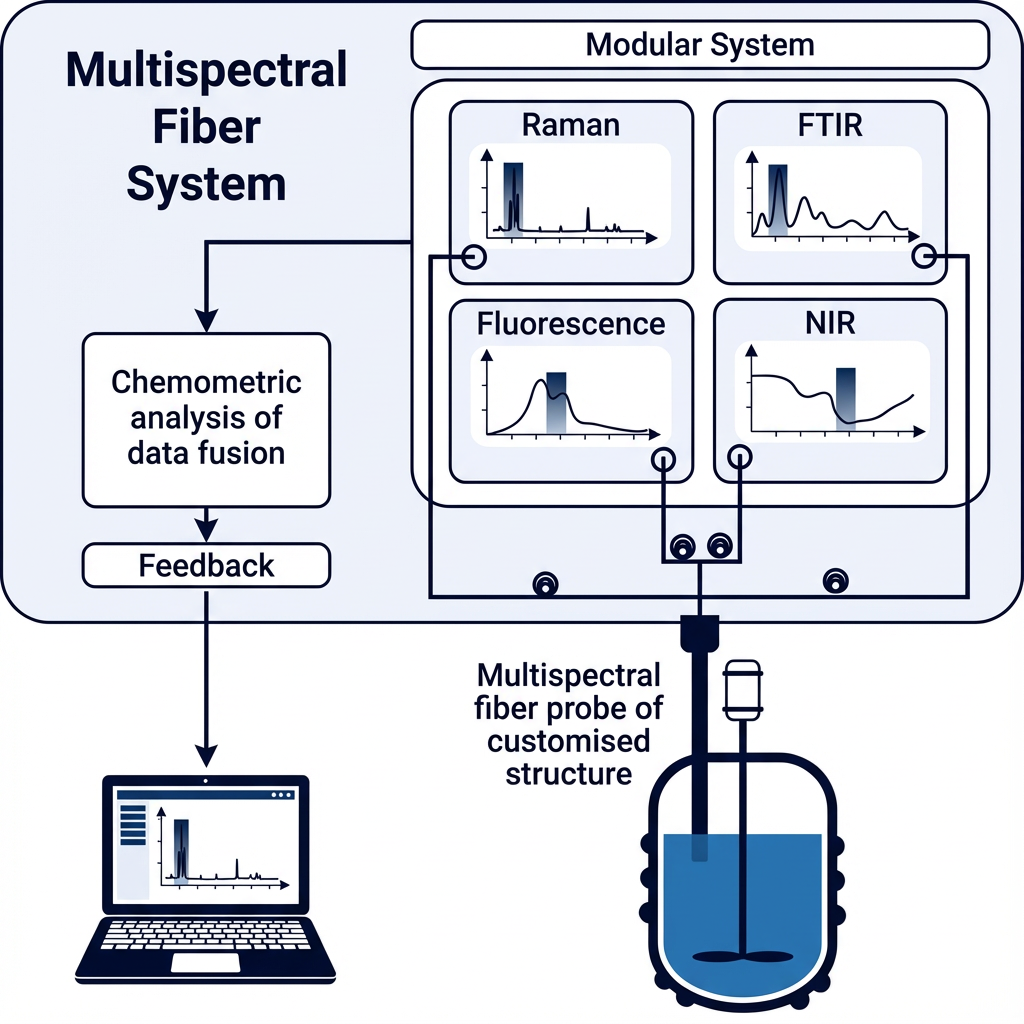
In modern manufacturing, relying on a single spectral method can leave facility operators and engineers with critical blind spots. Complex molecular reactions are rarely one-dimensional, and your Process Analytical Technology (PAT) should reflect that complexity.
A true in-line solution requires a comprehensive approach. At Art Fiber Systems (AFS), we recognize that capturing the complete picture of a chemical process means uniting multiple spectroscopic perspectives into one cohesive, real-time data stream.
Here is how our Multispectral Fiber Systems are designed to eliminate process blind spots and deliver complete analytical clarity:
Comprehensive System Architecture
Rather than relying on isolated instruments that only tell part of the story, we integrate multiple spectroscopic methods—including Raman, FTIR, Near-IR (NIR), and Fluorescence—into a single, modular system. This unified architecture ensures that a wider range of molecular behaviors and concentrations are monitored simultaneously.
Customized In-Situ Probes
Deploying multiple analytical methods traditionally meant cluttering a reactor with numerous sensors. AFS overcomes this limitation by utilizing a single, structurally customized multispectral fiber probe. This streamlined physical interface gathers all necessary optical data directly from the process stream without introducing unnecessary complexity or contamination risks to the reactor environment.
Advanced Chemometric Data Fusion
Gathering raw spectral data is only the first step in effective process control. Our system architecture feeds these diverse spectral inputs into advanced chemometric analysis. By fusing this data, the system pinpoints the most valuable spectral features across different wavelengths, cutting through the noise of complex, overlapping curves.
Delivering Actionable Feedback
Ultimately, this integrated approach ensures no critical process data is missed. The fused spectral fingerprint is instantly translated into precise, real-time feedback, enabling reliable automated control over the chemical process.
When you stop looking at isolated data streams and start analyzing the complete spectral picture, you unlock true process understanding. If your facility is currently relying on single-method sensors for complex reactions, it is time to rethink your solution architecture and explore what a unified multispectral system can achieve.