
Are you still relying on outdated data to control real-time reactions?
Understanding the difference between off-line, at-line, on-line, and in-line analysis is the first step toward true process control. When monitoring chemical processes, how you collect data directly dictates your operational efficiency and product quality.
Here is a breakdown of the standard analytical methods and how they impact your workflow:
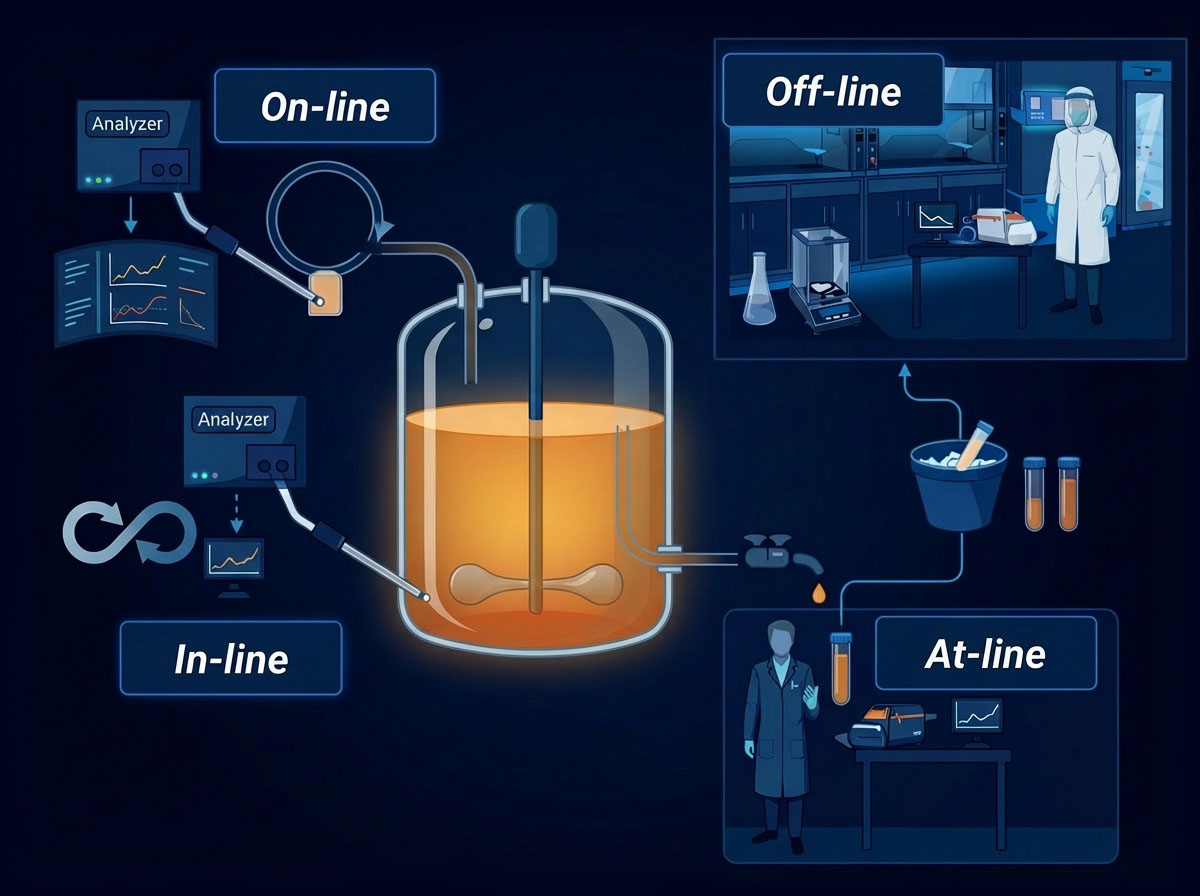
- Off-line: A sample is physically transported to a central lab for analysis. Waiting for results creates significant blind spots and introduces the highest risk of chemical changes or contamination during transit.
- At-line: Operators manually extract a sample to test at a nearby workstation. While faster than a central lab, this manual handling still introduces data latency, human error, and quality variance.
- On-line: A bypass loop automatically diverts fluid from the process to an external analyzer before returning it. This automated detour still creates a time lag between the actual reaction and the measurement.
- In-line: A robust probe sits directly inside the main reactor or pipe. Measurement happens continuously in real time—no extraction, no wait times, and zero blind spots.
In-line fiber spectroscopy provides instant, actionable insights that traditional extraction methods simply can’t match. By eliminating the need to divert or manually handle samples, facilities can transition from reacting to old data to actively optimizing their yield.
At AFS, we take the complexity out of this transition. We can be the fiber optic bridge between the spectrometer and your process, ensuring you capture every critical reaction shift exactly as it happens.